What Brands Actually Look for When Reviewing Influencer Applications (And How to Stand Out)
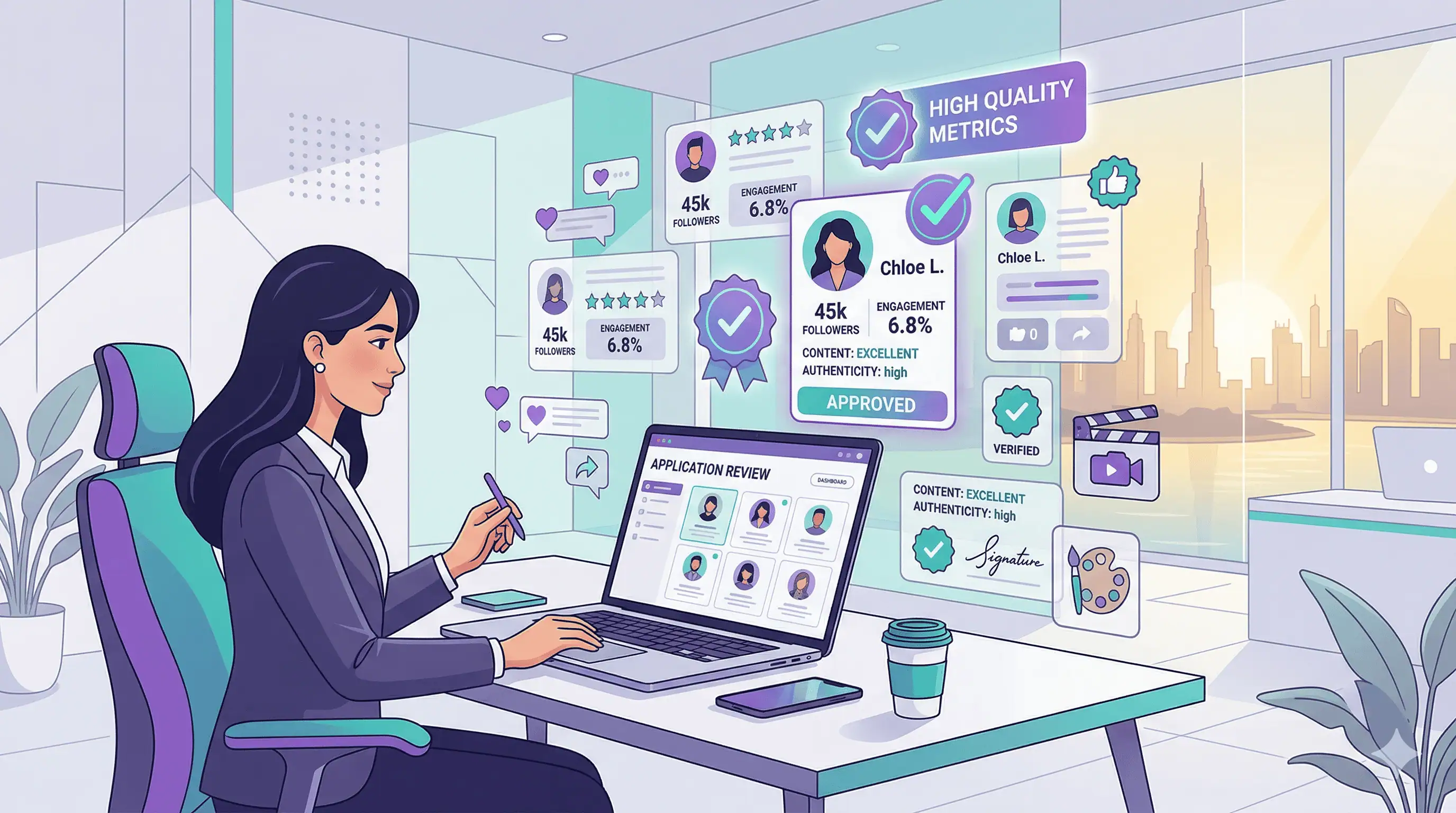
Every day, brands in the UAE and across the MENA region receive hundreds of influencer applications. Most get rejected within seconds. The difference between applications that land brand deals and those that get ignored often comes down to details that many influencers overlook. Here's what actually happens when brands review your application—and how to make yours stand out.
The First Thing Brands Notice (It's Not Your Follower Count)
Contrary to popular belief, follower count is rarely the deciding factor. Brands have learned that big numbers don't guarantee results. Here's what catches their attention first:
- Engagement Rate: A creator with 15,000 followers and 8% engagement is more valuable than one with 100,000 followers and 0.5% engagement. Brands calculate this immediately.
- Content Quality: Is your feed professional? Are photos and videos clear, well-lit, and visually appealing? First impressions form within seconds.
- Relevance: Does your content align with the brand's industry? A fitness brand isn't interested in a food blogger, no matter how impressive the metrics.
- Authenticity: Do your posts feel genuine, or does everything look like an advertisement? Brands want creators who can seamlessly integrate products into their content.
The truth is, most brands filter applications by engagement rate and relevance before looking at anything else. If these don't pass the threshold, your follower count becomes irrelevant.
How Your Application Gets Evaluated
Understanding the brand's review process helps you optimize your approach:
Stage 1: Initial Screening (30 seconds)
Marketing teams quickly scan applications, looking for obvious red flags and basic fit. They check:
- Profile photo and bio completeness
- Overall feed aesthetic and consistency
- Engagement rate at a glance
- Basic niche alignment
Stage 2: Deep Dive (2-5 minutes)
Applications that pass initial screening get closer examination:
- Recent content quality and frequency
- Previous brand collaborations (how they handled them)
- Comment section quality (real conversations vs. spam)
- Story engagement and consistency
- Audience demographics (if available)
Stage 3: Final Decision
Brand managers compare shortlisted creators and consider:
- Rate versus expected ROI
- Availability and responsiveness
- Unique value proposition
- Potential for long-term partnership
Verify Influencers for Free on Miqwal
OAuth-verified profiles with real engagement data straight from the platforms.
Red Flags That Get Applications Rejected
Avoid these common mistakes that immediately disqualify applications:
- Generic Application Messages: "Hi, I'd love to work with your brand!" without any personalization signals low effort. Brands want to feel you actually know and care about their products.
- Inconsistent Posting: Long gaps between posts suggest unreliability. Brands need creators who consistently produce content.
- Fake Engagement Patterns: Sudden spikes in followers, comments that don't match post content, or obvious engagement pod activity are immediate disqualifiers.
- Poor Previous Collaborations: If your feed shows low-quality sponsored content or products clearly misaligned with your niche, brands notice.
- Unprofessional Communication: Typos, vague messages, or failure to answer questions raise concerns about reliability.
- Unrealistic Rate Expectations: Demanding celebrity-level rates with mid-tier metrics frustrates brand managers.
What Makes an Application Stand Out
Here's how successful influencers differentiate themselves:
Personalization That Shows Research:
Reference specific products or campaigns the brand has run. Mention why you genuinely connect with their values. A sentence like "I loved your recent sustainability initiative—it aligns with the eco-conscious content I create" shows you've done homework.
Clear Value Proposition:
Don't just list your metrics. Explain what you bring to the table:
- "My audience is 70% UAE-based women aged 25-35, which matches your target demographic"
- "My Reels average 50K views with 8% engagement"
- "I can create content in both Arabic and English for broader reach"
Creative Ideas:
Proactively suggest content concepts. Brands appreciate creators who think beyond "I'll post about your product." Propose specific formats, angles, or storytelling approaches.
Social Proof:
Mention previous successful brand collaborations (if allowed by contracts). Share specific results: "My collaboration with [Brand X] generated 15,000 website clicks and sold out their limited edition within 48 hours."
Professional Media Kit:
Include a well-designed media kit with your demographics, rates, content examples, and testimonials. This signals professionalism and saves the brand time.
Download Our Free Book: The Comprehensive Guide to Influencer Marketing
A free 74-page Arabic book on sponsorship pricing, negotiating directly with brands, and landing your first sponsorship. Direct PDF download, no signup and no email.
- A clear formula for pricing sponsorships
- Five fundamentals of direct brand negotiation
- The steps to landing your first sponsorship
Building a Profile Brands Actually Want to Work With
Long-term success requires consistent investment in your profile:
Content Consistency:
Post regularly (at minimum 3-4 times per week on Instagram, daily on TikTok). Maintain a consistent aesthetic and voice. Brands want predictable quality.
Niche Authority:
Be known for something specific. "Dubai food blogger" is better than "lifestyle influencer." Specialization makes you the obvious choice for relevant brands.
Engagement Cultivation:
Reply to comments genuinely. Start conversations in your stories. Build a community, not just an audience. High engagement comes from real relationships with followers.
Portfolio Development:
Even without paid partnerships, create sponsored-style content for brands you love. This demonstrates your ability to create compelling branded content and gives brands confidence in what they'll receive.
Platform Diversification:
Being strong on multiple platforms (Instagram + TikTok, or YouTube + Instagram) makes you more valuable. Brands increasingly seek cross-platform campaigns.
The Importance of Timing Your Applications
When you apply matters almost as much as how you apply:
Apply Early:
Campaigns often receive hundreds of applications within the first 24-48 hours. Brand managers typically review applications in batches, and early applicants get more attention. Set up notifications for new campaigns in your niche and apply promptly with a well-crafted pitch.
Understand Campaign Cycles:
Brands plan campaigns around seasons and events. Ramadan campaigns are planned months in advance. Summer travel campaigns start recruiting in spring. UAE National Day content is coordinated in September-October. Understanding these cycles helps you prepare and apply at the right time.
Avoid Peak Competition Times:
Major campaigns from well-known brands attract overwhelming competition. While these are worth pursuing, also focus on smaller brands and niche campaigns where competition is lower and acceptance rates are higher. Building a track record with smaller brands can open doors to bigger opportunities.
Follow Up Appropriately:
If you haven't heard back within a week, a polite follow-up is appropriate. Keep it brief and professional: "I wanted to follow up on my application for [campaign]. I remain very interested and happy to answer any questions." Don't follow up more than once unless the brand responds.
Frequently Asked Questions
How do I know what rate to charge brands?
A common formula: charge AED 100-200 per 1,000 engaged followers for a feed post. For example, with 20,000 followers and 5% engagement (1,000 engaged followers), charge AED 1,000-2,000. Adjust based on content complexity, usage rights, and exclusivity requirements. Research what similar creators in your niche charge.
Should I apply to campaigns outside my niche?
Generally, no. Brands specifically seek influencers whose audiences match their target customers. Applying to misaligned campaigns wastes everyone's time and can hurt your reputation if you're seen as someone who'll promote anything for money.
How quickly should I respond to brand inquiries?
Within 24 hours whenever possible. Brands often work on tight timelines and will move to the next creator if you're slow to respond. Quick, professional responses signal reliability.
What should I do if a brand wants free collaboration?
Evaluate the opportunity. For new influencers, product-only collaborations with respected brands can build your portfolio. For established creators, free work devalues the industry. Consider offering a reduced rate for first collaborations with brands you genuinely want to work with long-term.
How do I stand out when hundreds of influencers apply to the same campaign?
Quality over speed. Take time to craft a personalized application that shows genuine brand knowledge. Include specific content ideas and demonstrate clear audience alignment. Most applications are generic—yours shouldn't be.
Do brands check if my followers are real?
Absolutely. Many brands use tools to audit influencer accounts for fake followers. Suspicious patterns get flagged immediately. Platforms like Miqwal verify accounts through OAuth, which helps brands trust the metrics they see. Never buy followers—it's obvious and ruins your credibility.
What information should I include in my media kit?
A professional media kit should include: a brief bio highlighting your niche and expertise, follower counts and engagement rates across platforms, audience demographics (age, location, gender breakdown), examples of your best content, previous brand collaborations with results (if applicable), your rates for different deliverables, and contact information. Keep it to 2-3 pages and update it quarterly.
How do I handle brands that ask for exclusivity?
Exclusivity means you cannot work with competing brands for a specified period. This limits your earning potential, so it should come with higher compensation. Ask clarifying questions: What categories are restricted? How long is the exclusivity period? What geographic scope applies? Negotiate compensation that reflects the opportunity cost of turning down other work during the exclusivity window.
Ready to Land Your First Brand Deal?
The best way to get noticed by brands is to be where they're looking. Join Miqwal's marketplace to connect with brands actively seeking influencers like you. Create your verified profile, showcase your best content, and start applying to campaigns that match your niche.
New to the platform? Use coupon code WelcomeToMiqwal for 50% off your first subscription—giving you unlimited campaign applications and priority visibility to brands.
Browse current opportunities on our influencer hub and start your journey to becoming a sought-after creator.
Ready to start influencer marketing?
Create your free accountAbout the Author
Miqwal Team
The Miqwal team: we write from platform data and from real collaborations between brands and Arab influencers.